


Hexachlorocyclotriphosphazene: macromolecular assemblies in vapor and crystalline phases. experimental and computational approach

Abstract
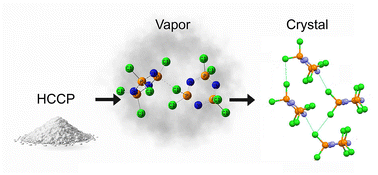
Hexachlorocyclotriphosphazene (HCCP) was obtained as a high-purity single-crystalline material suitable for X-ray diffraction analysis through a simple sublimation procedure under atmospheric pressure and mild heating. Mass spectrometry and quantum-chemical calculations were employed to investigate the self-association of HCCP in both solid and vapor phases. The presence of non-covalent intermolecular N⋯Cl and Cl⋯Cl interactions was revealed, explaining the chain-like supramolecular organization of HCCP in the crystal lattice, in which four-membered intermolecular rings are linked via halogen bonds. Gas-phase mass spectrometric data confirmed the formation of HCCP dimers and higher associates. The nature and strength of these halogen bonds were analyzed using the electrostatic potential (ESP), electron localization function (ELF), and Bader's topological analysis of the electron density. In addition, Hirshfeld surface analysis with fingerprint plots was employed to quantify intermolecular contacts in the crystal, and complementary quantum-chemical calculations using the B3LYP-D3 and APFD functionals were performed to validate and compare the description of non-covalent interactions.
 Please wait while we load your content...


