


Nitrogen coordination-regulated electronic structure of V-based single-atom M–N–C for efficient sodium storage

Abstract
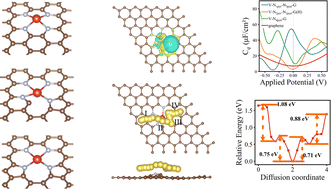
Sodium-ion capacitors (SICs) have emerged as highly promising next-generation energy storage devices, but their development is severely restricted by the lack of high-performance anode materials capable of addressing the challenges posed by the large ionic radius of Na+. Metal–nitrogen-doped carbon (M–N–C) single-atom materials (SAMs) offer a viable solution owing to their tunable electronic structures and high atomic utilization efficiency. In this study, density functional theory (DFT) calculations were employed to systematically investigate the sodium storage performance of vanadium (V)-based single atoms anchored on nitrogen-doped graphene (V–N4–G) with seven distinct pyrrolic (pyr)/pyridinic (pyd) nitrogen coordination configurations. Thermodynamic stability analysis revealed that three configurations—V–N4pyd–G, V–N1pyr–N3pyd–G, and V–N2pyr–N2pyd–G(H)—exhibit thermodynamic stability with negative formation energies. Further comprehensive evaluations of electronic properties, Na adsorption/diffusion behavior, and quantum capacitance (CQ) demonstrated that the V–N4pyd–G configuration achieves optimal overall performance: it possesses thermodynamic stability, a moderate Na binding energy (−2.27 eV), a low diffusion barrier (0.84 eV), and a high CQ of up to 78 µF cm−2. These findings uncover the critical role of coordination engineering in regulating the sodium storage performance of single-atom materials at the atomic scale, providing a solid theoretical foundation and novel insights for the design of high-performance SIC anodes.
 Please wait while we load your content...


