


YTaNO2 Janus MXene as an optimal electrocatalyst for the hydrogen evolution reaction
 a
Tarik
Ouahrani,
*ab
Ángel
Morales-García,
c
Michael
Badawi
d
and
Daniel
Errandonea
*e
a
Tarik
Ouahrani,
*ab
Ángel
Morales-García,
c
Michael
Badawi
d
and
Daniel
Errandonea
*e
Abstract
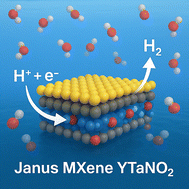
Janus MXenes, owing to their customizable electronic structure, tailored internal electric fields, and inherent out-of-plane asymmetry, constitute a promising platform for electrocatalysis. To optimize the hydrogen adsorption energetics of the parent Y2NO2 material for the hydrogen evolution reaction (HER), we perform a comprehensive first-principles study of a family of Janus YMNO2 MXenes (M = Sc, Ti, V, Cr, Zr, Nb, Mo, Hf, Ta, W). Phonon calculations indicate that YHfNO2 and YTaNO2 are dynamically stable, whereas the remaining compositions exhibit soft modes associated with charge imbalance or local lattice distortions induced by the substituted transition metal. The pronounced sensitivity of HER activity to metal substitution is further confirmed by hydrogen adsorption calculations, which reveal a broad range of binding strengths across the series. Among all the screened materials, YTaNO2 MXene displays a hydrogen adsorption free energy close to the thermoneutral value (ΔGH* ≈ 0 eV), placing it at the apex of the Sabatier volcano plot and indicating superior catalytic performance relative to the parent MXene and other Janus derivatives. This near-ideal behavior is rationalized through electronic-structure analysis, which reveals a quasi-semimetallic character with pronounced spin asymmetry and a Ta-derived d-band center located slightly below the Fermi level, enabling balanced hydrogen binding and efficient charge transfer. Overall, these results demonstrate that metal-layer substitution provides an effective strategy for enhancing the HER activity of Janus MXenes while tuning their intrinsic internal potential gradients.
 Please wait while we load your content...


