


The negligible effect of a single vacancy defect on ultrafast excitation energy transfer from porphyrin to single-walled carbon nanotubes
 *b
*b
Abstract
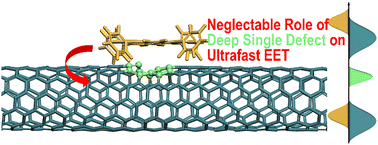
Single-walled carbon nanotubes (SWCNTs) possess remarkable optoelectronic properties and can be decorated with functional molecules to facilitate photoinduced excitation energy transfer (EET) and charge transfer (CT) processes. However, structural defects in SWCNTs are inevitably introduced during synthesis or irradiation, and their effects on the photoinduced dynamics of SWCNT-based nanohybrids remain poorly understood. In this work, the impact of a single vacancy (SV) defect on the excited state properties and the ultrafast photoinduced dynamical processes of a noncovalent SWCNT-based nanohybrid consisting of SV-CNT(6,5) and tetraphenylporphyrin (H2TPP) is investigated using excited state electronic structure calculations and nonadiabatic dynamics (NAMD) simulations with excitonic effects. Compared with the pristine counterpart H2TPP@P-CNT(6,5), a defect state emerges in H2TPP@SV-CNT(6,5), which affects the excitation energies and the corresponding excited state properties. However, ultrafast EET from H2TPP to SV-CNT(6,5) is observed, similar to the previously reported dynamical behavior of H2TPP@P-CNT(6,5), indicating that the SV-generated deep-level defect state has a negligible influence on the ultrafast EET dynamics. NAMD simulations reveal that the exciton transfer is dominated by adiabatic transfer during the first 10 fs and by nonadiabatic hopping during the following ∼1 ps. These findings elucidate the excited state dynamics of SV-defective SWCNT-based nanohybrids and highlight the negligible influence of deep-level defect states on the ultrafast photoinduced dynamics of defective nanocarbon systems.
 Please wait while we load your content...


