Microscopic origin of quantum plasticity in small H3+(H2)n (n = 1–3) clusters revealed by path integral molecular dynamics simulations

Abstract

We investigate the microscopic origin of “quantum plasticity,” i.e., flexible molecular geometries induced by nuclear quantum effects, in small H3+(H2)n (n = 1–3) clusters using first-principles path integral molecular dynamics simulations. Nuclear quantum effects soften the rotational barriers of the H2 ligands, stabilizing structurally flexible configurations absent in classical descriptions.
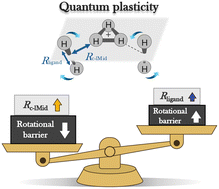
Graphical abstract: Microscopic origin of quantum plasticity in small H3+(H2)n (n = 1–3) clusters revealed by path integral molecular dynamics simulations

Supplementary files

Article information

Article type
Communication
Submitted
04 Jan 2026
Accepted
17 Feb 2026
First published
26 Feb 2026

Phys. Chem. Chem. Phys., 2026, Advance Article

Microscopic origin of quantum plasticity in small H3+(H2)n (n = 1–3) clusters revealed by path integral molecular dynamics simulations

K. Nishikawa, H. Tanaka, K. Kuwahata, M. Tachikawa and T. Udagawa, Phys. Chem. Chem. Phys., 2026, Advance Article , DOI: 10.1039/D6CP00022C

To request permission to reproduce material from this article, please go to the Copyright Clearance Center request page.

If you are an author contributing to an RSC publication, you do not need to request permission provided correct acknowledgement is given.

If you are the author of this article, you do not need to request permission to reproduce figures and diagrams provided correct acknowledgement is given. If you want to reproduce the whole article in a third-party publication (excluding your thesis/dissertation for which permission is not required) please go to the Copyright Clearance Center request page.

Read more about how to correctly acknowledge RSC content.

Social activity

Spotlight

Advertisements