


Unravelling the promising di-substitution pattern boosting radiative and reverse intersystem crossing rates in 1,8-naphthalimide D–A–D emitters: a computational study

Abstract
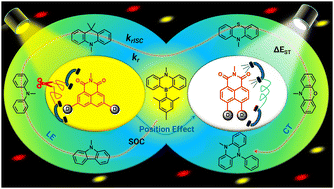
Understanding how substitution topology governs excited-state processes is central to the rational design of high-performance organic emitters. Herein, eighteen symmetrically substituted D–A–D molecules were designed by combining a naphthalimide acceptor with nine electron-donating groups, and their electronic and photophysical properties were systematically investigated using density functional theory. Symmetric donor substitution at the C3,C6 and C4,C5 positions of the naphthalimide core was considered to elucidate regio-dependent structure–property relationships. In general, the 4,5-disubstituted derivatives exhibit smaller singlet–triplet energy gaps (ΔEST) in the ground state, except for the diphenylamine derivative, primarily due to increased donor–acceptor twisting. In contrast, several 3,6-disubstituted derivatives bearing strong donors also display reduced ΔEST values. Molecules with smaller root-mean-square deviations between optimized S1 and S0 geometries undergo reduced structural reorganization upon excitation, which is expected to suppress non-radiative decay via internal conversion and favour higher radiative rates. Accordingly, the 3,6-disubstituted derivatives generally show larger oscillator strengths and higher radiative decay rates than their 4,5-substituted counterparts. Notably, 3,6-disubstituted systems incorporating diphenylamine and 10,11-dihydro-5H-dibenzo[b,f]azepine exhibit particularly high radiative rates. Intersystem crossing (ISC) rates are typically larger for the 3,6-disubstituted derivatives, with deviations attributable to differences in spin–orbit coupling matrix elements, while the 5H-dibenzo[b,f]azepine derivatives show consistently high ISC rates irrespective of the substitution pattern. Reverse intersystem crossing (RISC) is most efficient for phenoxazine- and 5-phenyl-5,10-dihydrophenazine-based systems, largely independent of regio-substitution. Overall, while 3,6-disubstitution often promotes stronger radiative and ISC processes, donor identity plays a decisive role in facilitating RISC and enabling TADF behaviour. These results provide clear design insights into how regio-controlled substitution and donor selection jointly govern fluorescence, phosphorescence, and TADF pathways in naphthalimide-based emitters.
 Please wait while we load your content...


