



Stoichiometric dependence of the structural and electronic properties of HfX2(1−x)X2x (X = S, Se, Te) monolayers
 *a
and
*a
and
Abstract
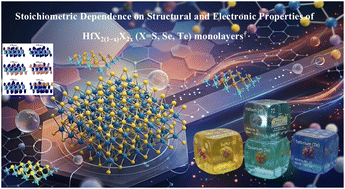
Stoichiometric variation strongly influences the structural and electronic properties due to changes in their charge symmetries. This study uses density functional theory to analyze the structural and electronic properties of Hf-based alloys, i.e., HfS2(1−x)Se2x/Te2x, HfSe2(1−x)S2x/Te2x, and HfTe2(1−x)S2x/Se2x, which have been examined with various doping concentrations (0.11, 0.22, 0.33, and 0.44). Hf-alloys’ structural and mechanical stability strongly depends on the doping ratio. The results show that HfTe2-alloys with S/Se doping outperform the other two HfS2 and HfSe2 alloys in terms of stability. It has been observed that the band gap can be tuned from semiconducting to semi-metallic to metallic. The band gap alignment remains indirect in HfS2(1−x)Se2x/Te2x, and HfSe2(1−x)S2x/Te2x. Hf-based alloys have lower carrier effective masses  in the range of 0.01–0.04. The results suggest that variation in the stoichiometric ratio in Hf-based alloy systems could be used for designing novel electrical devices.
 Please wait while we load your content...


