


 PLATFORM UPDATE:


Modelling magnetic confinement in two-dimensional quantum dots via gauge-invariant imaginary-time propagation†
 *b
*b
Abstract
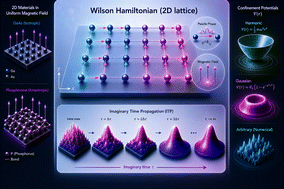
We develop a real-space framework for modelling magnetically confined states in two-dimensional quantum dots, which constitute a field of intense experimental and theoretical study in view of potential applications in quantum technology, directional electronics and magneto-sensing, for instance. The method integrates a Wilson-type finite-difference discretization leading to the Wilson Hamiltonian (WH), which enforces exact local U(1) gauge invariance on the lattice, with imaginary-time propagation (ITP) as an efficient and numerically stable eigensolver. This combination eliminates gauge-dependent artefacts that commonly arise when the vector potential directly features in the Hamiltonian and enables accurate treatment of arbitrary confinement potentials. Benchmark calculations on GaAs quantum dots with harmonic and Gaussian trapping potentials demonstrate sub-cm−1 agreement with analytical and variational benchmarks across a wide range of magnetic fields, including the Landau regime. The approach is further applied to quantum dots formed in monolayer phosphorene, where strongly anisotropic effective masses and confinement potentials give rise to characteristic field-dependent level shifts and reordering. In addition to the energies, we introduce quantitative parameters and examine the evolution of the corresponding wavefunctions, showing that the method accurately reproduces magnetic-field-induced contraction, nodal structures, and angular-momentum-driven radial reorganization. These results indicate that the WH-ITP method could be a robust and versatile tool for modelling magnetic confinement and electronic structure in two-dimensional quantum dots and related nanoscale materials.
- This article is part of the themed collection: Structure and dynamics of chemical systems: Honouring N. Sathyamurthy’s 75th birthday
 Please wait while we load your content...


