


Room temperature phosphorescence based on triplet–triplet energy transfer in host–guest systems: excited-state alignment and rational design using range-separated hybrids

Abstract
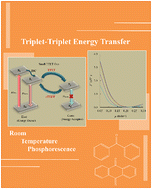
Regulation of room temperature phosphorescence (RTP) based on the triplet–triplet energy transfer (TTET) between the host (H) and guest (G) units in H/G systems has recently come into limelight. As the key feature of this mechanism, accurately accounting for the triplet excited-state alignment of the involved units is of paramount importance. To properly address this issue from the theoretical viewpoint, in this work, the TTET-based RTP in H/G systems is thoroughly investigated using optimally tuned range-separated hybrid (OT-RSH) models. To do so, several experimentally proven-to-work H/G pairs with the regulated RTP based on the TTET have been considered as working systems. For a reliable description of the triplet energy level alignment in these pairs, we have proposed and validated variants of the OT-RSHs as well as the related versions based on the linear-response and state-specific formalisms within the polarizable continuum model with both equilibrium and nonequilibrium solvation regimes. Within our analyses, the impact of the used methodologies including time-dependent density functional theory and Tamm–Dancoff approximation as well as the role of underlying density functional approximations, short-range and long-range Hartree–Fock exchange, and the range-separation parameter has been examined. On the basis of our results it is unveiled that many of the combinations of the parameters in OT-RSHs cannot deliver reliable TTET gaps between the H and G units for the efficient RTP in H/G systems, but a particular compromise among them is essential for well describing the regulated RTP based on the TTET. In search of the qualified blending ingredients for reliable prediction of the TTET gaps, we present our best OT-RSH model, outperforming conventional hybrids as well as the standard RSHs with the default parameters. To expand the scope of the study, the applicability of our proposed method is also put into broader outlook, where its performance for computational design of several H/G systems prone to be employed in the RTP materials based on the TTET is showcased. It is anticipated that the presented OT-RSH in this study can be considered as a cost-effective tool for theoretical rational design as well as for verifying experimental observations in the context of TTET-based RTP in H/G systems.
 Please wait while we load your content...


