


 PLATFORM UPDATE:


Nanoplastics penetration across the blood–brain barrier
 c
and
Baofu
Qiao
*a
c
and
Baofu
Qiao
*a
Abstract
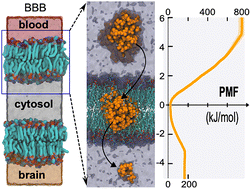
Microplastics and nanoplastics (MNPs), originating from plastic degradation, have arisen to be a threat to ecology and human health. Alarmingly, the penetration of MNPs across the highly selective blood–brain barrier (BBB) poses an emerging and urgent risk, yet its molecular mechanism remains unexplored. In this work, using long-time-scale (over 28 microseconds) all-atom explicit solvent steered molecular dynamics, we examine the free energy of the passive permeation of four polymer nanoparticles: polyethylene (PE), polypropylene (PP), polystyrene (PS), and polyethylene terephthalate (PET). PE, PP, and PS nanoparticles exhibited a remarkable preference for entering the BBB, attributed to their high hydrophobicity, though they are kinetically trapped in the aqueous phase. In contrast, the PET nanoparticle was energetically unfavored for entering the BBB. Our study further reveals that the PE, PP, and PS polymers can enter the BBB as polymerized nanoplastics, dissolve within the BBB, and eventually exit as dispersed polymer chains, which is specifically true for the amorphous PP and PS nanoparticles. Moreover, the crystalline structure of the PE nanoparticle drives distinct orientations during the penetration process, and the insertion of the PET nanoparticle elevates the hydration of the bilayer interior. Our work advances the knowledge about the mechanism of nanoplastic penetration across the BBB, which could aid in the rational design of therapeutics for nanoplastic penetration inhibitors.
 Please wait while we load your content...


