


Field-nanoconfinement coupling enhanced water desalination in carbon nanotubes

Abstract
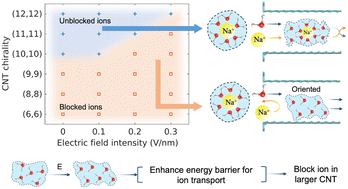
Desalination based on carbon nanomembranes offers high water permeance and salt rejection, making them promising for addressing global freshwater shortages and energy demands in reverse osmosis (RO) desalination. Enhancing ion rejection by modulating the energy barrier for ion transport through wide carbon nanotubes (CNTs) is a critical challenge for highly efficient desalination. We perform molecular dynamics simulations on water desalination using CNTs membranes, highlighting the key role of nanoconfinement coupled with an electric field. The results show that the electric field extends the threshold of CNT diameter required for complete ion rejection from 1.10 nm to 1.50 nm, achieving ∼100% ion rejection while maintaining water permeance of ∼97 L cm−2 day−1 MPa−1. The calculated energy barriers for ion transport demonstrate that the applied electric field significantly increases the inhibitory effect of wide CNTs on ion permeation. We elucidate that the molecular mechanism governing the free energy barrier of ion arises from the polarization of confined water induced by the coupling of the electric field and CNTs, leading to the stripping and reorganization of the ion hydration shell. This approach achieves water permeance that is up to three orders of magnitude higher than that of commercial RO membranes, enhancing the application potential of CNTs membranes coupled with external fields for water desalination. We expect this work to be valuable for understanding the thermodynamic and kinetic behaviors of solute transport and separation induced by molecular mechanisms.
 Please wait while we load your content...


