


Halide perovskite scintillators for X-ray detection: from structure to engineering
 *ab
A. R.
Tameev
d
and
*ab
A. R.
Tameev
d
and
Abstract
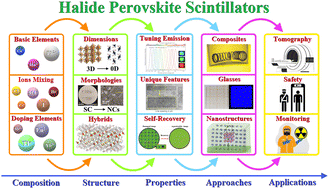
Halide perovskites (HPs) and their derivatives are emerging as a prominent class of materials for ionizing radiation detection. A unique combination of high atomic numbers, efficient luminescence, tunable optoelectronic properties, defect tolerance and low synthesis cost positions them as a promising alternative to traditional scintillators. The review overviews fundamental principles governing perovskite scintillator operation, from radiation absorption to charge carrier generation and recombination. We present a detailed classification of these materials based on structural dimensionality (3D to 0D) and morphology (single crystals (SCs), polycrystalline films, and nanocrystals (NCs)), alongside a discussion of their synthesis methods and the resulting impact on scintillation characteristics. The review highlights compositional and structural engineering techniques, such as activator ion doping, solid-solution formation, and defect passivation. These strategies yield record-breaking performance metrics that rival commercial counterparts, including high light yields (LYs) (>150 000 ph MeV−1), low limits of detection (LoDs) (<10 nGyair s−1), ultrafast responses (<1 ns), and high spatial resolution (>100 lp mm−1). We also discuss the fabrication of composite scintillating screens using polymer and glass matrices, and explore nanostructured systems offering enhanced flexibility, stability, and spatial resolution. Finally, we address key challenges, such as toxicity, scalability, and long-term stability, and outline promising future directions, including the development of multifunctional scintillators, the engineering of materials for photon-counting detectors, the application of emerging paradigms like supramolecular chemistry and nanophotonics, and advancements in data-driven discovery and machine learning technologies.
- This article is part of the themed collection: 2026 PCCP Reviews
 Please wait while we load your content...


