


Lung cancer targeting by trimethoxy flavans: a molecular simulation study

Abstract
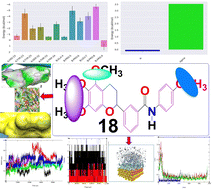
The therapeutic potential of a series of trimethoxyflavan derivatives (1–24) against non-small cell lung cancer (NSCLC) was evaluated through a comprehensive in silico strategy integrating structure-based virtual screening, molecular docking, molecular dynamics (MD) simulations, MM/PBSA binding free-energy calculations, density functional theory (DFT) analysis, and ADMET profiling. All derivatives were benchmarked against the reference drugs genistein and cianidanol. Docking against nine cancer-related protein targets identified compound 18, N-(4-methoxyphenyl)-3-(5,6,7-trimethoxychroman-2-yl)benzamide, as the most potent candidate, exhibiting strong affinities toward Keap1 (PDB: 1X2J; −9.1 kcal mol−1) and HER2/erbB2 (PDB: 3PP0; −8.4 kcal mol−1), outperforming both reference molecules. MD simulations at 300, 305, 310, and 320 K confirmed the stability of the Keap1-compound 18 complex, as reflected by consistent RMSD and RMSF profiles. Principal component analysis (PCA) revealed stable conformational sampling, with the first three principal components accounting for ∼45–50% of the total variance. Meanwhile, cosine contents (0.86–0.92) across all temperatures indicated reliable trajectory convergence. DFT calculations corroborated the electronic stability and reactivity of the lead compound, and PASS/ADMET predictions indicated a favorable bioactivity spectrum and drug-like pharmacokinetic properties. Supported by available in vitro evidence, these computational findings highlight compound 18 as a promising lead candidate for NSCLC, warranting further in vivo validation and potential advancement toward clinical development.
 Please wait while we load your content...


