


Origin of the shoulder peak in sum-frequency vibrational spectroscopy of interfacial water
 *a
*a
Abstract
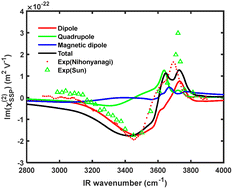
Water interfaces play critical roles in numerous physicochemical processes, with significant implications for green energy, atmospheric science, materials research, biological systems, and chemical reactions. Sum-frequency vibrational spectroscopy (SFVS) is a sensitive and selective nonlinear technique for probing interfacial molecular orientations, structures, and dynamics in situ. By combining ab initio molecular dynamics simulations and quantum chemistry calculations—which explicitly account for electronic quantum effects—we compute the imaginary part of the SSP SFVS for interfacial water. Our results demonstrate that the shoulder peak of the free OH group stems from both the electric quadrupole and magnetic dipole contributions, with the former being dominant. This approach balances simplicity with physical rigor, potentially offering a new theoretical framework for interpreting complex SFVS.
 Please wait while we load your content...


