


Structural and thermal stability of B4C/Ru multilayers with carbon barrier layers

Abstract
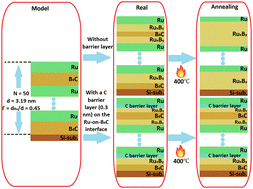
Analysis of the chemical interaction between B4C and Ru layers in multilayer structures depending on the thickness ratio (Γ) was carried out using X-ray photoelectron spectroscopy, X-ray diffraction and X-ray reflectometry. The results showed significant interlayer interaction with the formation of ruthenium borides, and it was found that an increase in the thickness of the B4C layer (a decrease in the Γ parameter) leads to the appearance of borides of different stoichiometries. The introduction of a carbon barrier layer at the Ru-on-B4C interface resulted in significant suppression of ruthenium boride formation. The thermal stability of the B4C/Ru system was also studied upon annealing at 400 °C for 1 hour before and after the introduction of the carbon barrier layer. It was shown that the introduction of a carbon barrier layer at the Ru-on-B4C interface increases the thermal stability of the system, which makes this system more suitable for use in optical systems exposed to long-term radiation. The obtained results are important for the development of highly efficient multilayer mirrors used in EUV lithography and X-ray optics.
 Please wait while we load your content...


