


Modulating excited state via diversified electron-donating units in MR-TADF emitters: a theoretical exploration of structure–property relationships
 a
a
Abstract
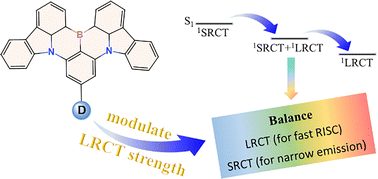
Multi-resonant thermally activated delayed fluorescence (MR-TADF) molecules have emerged as promising candidates for high-resolution organic light-emitting diode (OLED) displays. However, their performance is often limited by intrinsically large singlet–triplet energy gaps (ΔEST), leading to an unsatisfactory reverse intersystem crossing rate (kRISC). Herein, we systematically investigate how to modulate excited-state characteristics by strategically integrating diversified electron-donating units with an MR skeleton, enabling rational control over short-range charge transfer (SRCT) and long-range charge transfer (LRCT) components. The excited-state characters of S1, including SRCT, SRCT + LRCT, and LRCT, are achieved by fine-tuning the donor and MR interactions. Compared with unsubstituted analogues, the increase of the LRCT component significantly reduces ΔEST, thereby elevating kRISC values. However, the LRCT-dominated S1 states show broad and structureless emission spectra due to substantial relaxation energy. For molecules with mixed SRCT and LRCT characters, triplet up-conversion occurs efficiently owing to the small ΔEST mediated by the mixed characters. Furthermore, the SRCT character with relatively small relaxation energy relevant to the S1 → S0 process could help achieve narrowband emission. This work establishes a molecular design framework for high-efficiency and narrowband MR-TADF materials, highlighting the critical role of donor unit engineering in exciton utilization and color purity.
 Please wait while we load your content...


