


Mechanistic insights into the inhibition of hIAPP fibrillation by amyloidogenic core-derived peptide NFGAILSS using computer simulations

Abstract
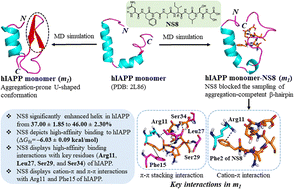
The fibrillation of human islet amyloid polypeptide (hIAPP) to cytotoxic oligomer species and amyloid fibrils is a significant pathological factor in type 2 diabetes (T2D). Thus, targeting hIAPP fibrillation offers a promising strategy for T2D prevention and treatment. Sivanesam et al. reported that NFGAILSS (abbreviated as NS8) inhibits hIAPP monomer (50 µM) fibrillation by 79–85% in the presence of 1 and 0.4 stoichiometric levels and restricts the conformational transitions of hIAPP from random coil to aggregation-competent β-sheet-rich oligomers. However, the mechanism by which NS8 inhibits hIAPP fibrillation remains unclear. Thus, molecular dynamics (MD) simulations were employed to unveil the inhibitory mechanism of NS8 against hIAPP fibrillation and examine the influence of NS8 on conformational changes and structural transitions in hIAPP. Notably, NS8 significantly augmented the helix in hIAPP from 37.00 ± 1.85 to 46.00 ± 2.30% and prevents its conformational shift to aggregation-prone β-sheet conformations. Remarkably, aggregation-competent β-hairpin structures were noticed at the amyloidogenic core (Ser20–Ser29) and C-terminal regions of hIAPP during simulation, which, notably, disappear on the incorporation of NS8. Importantly, MM-GBSA analysis depicted favourable binding (ΔGfit = −6.03 ± 0.09 kcal mol−1) of NS8 to hIAPP, driven predominantly by van der Waals interactions. The conformational microstate analysis depicts that the synergistic effect of hydrogen bonds, aromatic interactions, cation–π interaction, and hydrophobic contacts significantly enhances the binding of NS8 to hIAPP, leading to the NS8-mediated prevention of conformational transitions in hIAPP. Overall, this study illuminates the key interactions by which NS8 binds to hIAPP, promoting its stabilization in a non-aggregation competent α-helical conformation and impeding its fibrillation to cytotoxic species.
 Please wait while we load your content...


