


 PLATFORM UPDATE:


Theoretical study of Si/C alternately substituted annulenes with a belt structure
 *ab
Mark S.
Gordon
*c
*ab
Mark S.
Gordon
*c
Abstract
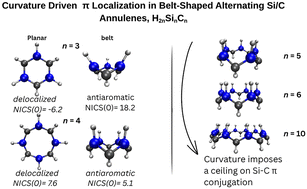
Alternating Si/C belt-shaped annulenes, H2nSinCn (n = 3, 4, 5, 6, and 10), representing a third class of annulenes beyond the planar and Möbius types, were investigated through quantum chemical calculations. Notably, the Si–C bond length alternation is not observed regardless of the number of π electrons (e.g., 4n or 4n + 2). For the smaller molecules (n = 3 and 4), the belt-shaped isomers were found to be less thermodynamically stable than their planar counterparts, benzene (n = 3) and cyclooctatetraene (n = 4), due to distorted π orbitals and strained ring structures. The quasi-atomic orbital (QUAO) analysis reveals that the planar n = 3 Si/C annulene exhibits delocalized π bonding with weak aromatic stabilization, while its belt-shaped counterpart shows hybridization-induced π localization and antiaromatic character. Both n = 4 systems (planar and belt-shaped) are intrinsically antiaromatic, although geometric distortion in the belt isomer partially alleviates this destabilization. As the ring size increases (n ≥ 5), the Si–C π orbitals become increasingly localized due to geometric constraints, in contrast with the uniform delocalization observed in the all-carbon analog H20C20. Notably, in the larger annulenes (n = 5, 6, and 10), the curvature of the belt structure imposes a ceiling on π conjugation. These results underscore the key role of geometry and QUAO asymmetry in modulating antiaromaticity in Si/C belt systems.
 Please wait while we load your content...


