


Unraveling the stereoisomeric toxicity of V-series nerve agent VX on human acetylcholinesterase: a well-tempered metadynamics study
 c
and
Bishwajit
Ganguly
*ab
c
and
Bishwajit
Ganguly
*ab
Abstract
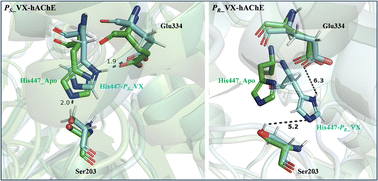
Highly toxic organophosphorus nerve agents exert their severe toxicity by inhibiting AChE irreversibly through the phosphonylation of Ser203 within the catalytic triad. The inhibition of AChE varies with stereoisomeric nerve agents. The inhibition mechanism of AChE by stereoselective nerve agents remains elusive. This study explores the mechanism of inhibition of hAChE by stereoselective nerve agents using well-tempered metadynamics (WT-MtD) simulations. The stereoisomeric nerve agent VX (in PS and PR forms) has been examined because it is known from the literature that the PS form of VX inhibits human AChE faster than the PR form. The 1D free energy surface profiles from the WT-MtD simulations reveal that the PS_VX nerve agent binds more strongly (∼4.0 kcal mol−1) with hAChE than the PR_VX nerve agent. The WT-MtD simulation results showed that the catalytic triad residues Ser203, His447, and Glu334 play an important role in governing the inhibition process of hAChE by stereoisomeric VX nerve agents. The catalytic triad Ser203, His447, and Glu334 of hAChE aligns in a very similar fashion to that observed for the hydrolysis of acetylcholine (ACh) by PS_VX. The aligned triad residues assist in generating the nucleophilic center at Ser203 for attack on the electrophilic phosphorus center of PS_VX more effectively than PR_VX. The WT-MtD snapshots taken from basin I for both stereoisomers of the nerve agents, used for superimposition onto the apo crystal structure of hAChE, show that the catalytic triad of PR_VX bound hAChE is not aligned with the catalytic triad of the crystal structure. The role of water molecules in the slower inhibition of PR_VX has also been investigated.
 Please wait while we load your content...


