


 PLATFORM UPDATE:


Regioisomer-directed structural diversity in one-dimensional silver(i) coordination polymers

Abstract
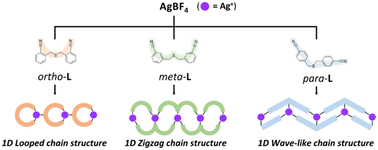
Building on previous studies demonstrating molar ratio-dependent supramolecular isomerism and anion-directed structural transformations in silver(I) coordination polymers, we investigated the role of ligand regioisomerism under conditions where anion coordination is minimized. Regioisomeric forms (o-L, m-L and p-L) of a flexible bis(cyanobenzyl) sulfide ligand were employed to explore their intrinsic structural directing ability in the presence of a weakly coordinating BF4− anion. Unlike earlier systems in which strongly coordinating anions significantly influenced ligand conformation and network topology, the use of BF4− allows the structural outcomes to be governed predominantly by ligand geometry and conformational flexibility. Single crystal X-ray diffraction analysis reveals that each regioisomer gives rise to a distinct one-dimensional coordination polymer, despite sharing an identical molecular backbone. The observed structural diversity arises from regioisomer-dependent variations in coordination modes, ligand conformations, and secondary intermolecular interactions. These results highlight that, in the absence of strong anion coordination, ligand regioisomerism plays a decisive role in directing the assembly of coordination polymers. This study provides deeper insight into the interplay between ligand flexibility, positional isomerism, and coordination geometry, offering a rational strategy for controlling structural diversity in metal–organic systems.
 Please wait while we load your content...


