


 PLATFORM UPDATE:


Coordination pyramid inversion, angular cluster core and homochiral single-stranded helix formation in polynuclear Mn(ii) assemblies supported by a bicompartmental salen-type ligand based on an o-xylylenediamine platform
 a
Aidar T.
Gubaidullin,
a
Alexander S.
Ovsyannikov,
*a
Svetlana E.
Solovieva
a
and
Igor S.
Antipin
b
a
Aidar T.
Gubaidullin,
a
Alexander S.
Ovsyannikov,
*a
Svetlana E.
Solovieva
a
and
Igor S.
Antipin
b
Abstract
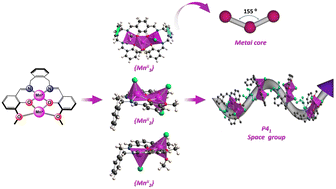
Although salen-type compartmental ligands have a rich history, these fascinating compounds still attract considerable attention due to the wide potential applications that their complexes can exhibit. By varying the flexibility of the spacer group, connecting two NO-chelating salicylideneamine moieties, and adjusting the type of anchored additional binding sites or co-ligands used, the formation of 3d metal clusters with the desired nuclearity can be achieved. In this work, we report the synthesis of two new binuclear {MnII2} (1-Mn2Cl3 and 1-Mn2Cl2) clusters and one angular (pseudo-linear) trinuclear {MnII3} (12-Mn3Cl2) cluster, supported by an o-xylylenediamine Schiff base derivative, bearing o-methoxy-substituted salicylideneamine units and acting as a bicompartmental ligand. The structures of prepared Mn-based complexes were established by single crystal X-ray diffraction (SCXRD), revealing the role of o-xylylenediamine platform on the diversity of observed coordination motifs. For the first time, in the case of {MnII2} clusters, displaying a similar coordination motif, it was established that the Mn atom, accommodated within the N2O2 coordination pocket, can adopt two different orientations of the MnN2O2Cl coordination pyramid relative to the o-xylylene spacer group. Additionally, the simultaneous effect of H-bonding, electrostatic and CH/π interactions between the anionic 1-Mn2Cl3 cluster and the NHEt3 cation species leads to the formation of helices, stacked in a homochiral crystal with the polar chiral P41 space group, which is reported for the first time for complexes based on salen-type ligands. Finally, the formation of the trinuclear complex 12-Mn3Cl2, exhibiting an unusual angular motif of the cluster core, stabilized by the ligand structure and intramolecular CH/π-bonding, is observed.
 Please wait while we load your content...


