


Construction of a three-dimensional flower-like Bi2S3/BiOCl S-scheme heterojunction and its efficient photocatalytic degradation of ciprofloxacin
 *a
*a
Abstract
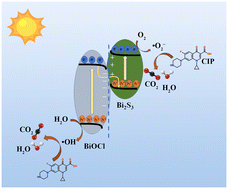
In this paper, a Bi2S3/BiOCl S-scheme heterojunction photocatalyst (BS-x) with a three-dimensional flower-like hierarchical structure was successfully constructed by co-precipitation and ion exchange. The characterization results show that Bi2S3 is uniformly modified on the surface of BiOCl in the form of a thin layer, forming a close interface contact and effectively extending the light response range of the composite material to the visible light region. Photoelectrochemical tests and photoluminescence spectra confirm that the heterojunction can significantly promote the separation and migration of photogenerated carriers. Under visible light irradiation, the optimal sample BS-0.5 exhibited excellent photocatalytic degradation performance for ciprofloxacin (CIP). The degradation rate reached 82.11% within 60 minutes, and the reaction rate constant (0.02102 min−1) was 3.1 times and 8.3 times those of pure BiOCl and Bi2S3, respectively. Free radical trapping experiments and energy band structure analysis show that photogenerated holes (h+) and superoxide radicals (·O2−) are the key active species that dominate the reaction, and their formation is due to the S-scheme charge transfer mechanism followed by the heterojunction. The S-scheme structure not only promotes charge separation, but also retains the strong redox capacity of the system to the greatest extent, thus significantly improving the CIP degradation efficiency. This study provides a new idea for the design of high-performance S-scheme heterojunction photocatalysts for the efficient degradation of antibiotics in water.
 Please wait while we load your content...


