


Substituent effect on the synthesis and magnetic properties of carboxylic acid ligand coordinated dysprosium complexes

Abstract
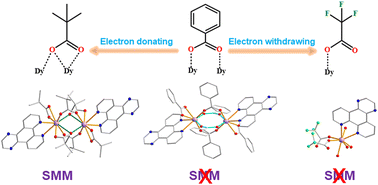
Three DyIII compounds, [Dy2(PhCOO)6(L3)2]·2DMF (1), [Dy(CF3COO)2(L3)(H2O)4]·CF3COO·CF3COOH·4L3·3H2O (2), and [Dy2((CH3)3CCOO)6(L3)2] (3), were synthesized by reacting dysprosium salts with different carboxylic acids as primary ligands and L3 (L3 = dipyrazine [2,3-f:2′,3′-h] quinoxaline) as the auxiliary ligand. Compounds 1 and 3 are binuclear, while compound 2 is mononuclear. In compounds 1 and 2, the DyIII ions are eight-coordinate, whereas in compound 3, the DyIII ions are nine-coordinate. The choice of carboxylic acid ligands not only influences the coordination geometries of the DyIII ions but also affects the nuclearity of final products. Magnetic tests show that compounds 1 and 2 are not SMMs, while compound 3 is a field-induced SMM. Compounds 1–3 share the same auxiliary ligand L3 but differ in the primary carboxylate ligands. It can be observed that the carboxylate ligands exhibit different coordination modes because of the different electron donating or withdrawing ability of the substituents in the carboxylate ligands, which leads to different coordination geometries of the DyIII ions or the nuclearity, indicating that the magnetic properties of SMMs are strongly correlated with both the steric bulk of the carboxylate ligands and the symmetry of their coordination geometry.
 Please wait while we load your content...


