


Room temperature phosphorescence and photochromism in a series of pyridine-based hybrid compounds
 a
Jie
Pan
*a
a
Jie
Pan
*a
Abstract
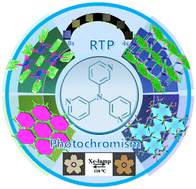
Metal–organic coordination polymers (CPs), with the advantages of a simple preparation process and tunable optical properties, provide an ideal platform for constructing high-performance room temperature phosphorescence (RTP) systems. Here, by using the pyridine derivative tri(pyridin-3-yl)amine (TPA), a series of Cd-based compounds namely [Cd2Cl4(TPA)(DMA)] (1), [Cd3Cl6(TPA)2] (2), [Cd(NO3)2(TPA)(DMF)] (3) and [Cd2(NO3)4(TPA)2(DMA)2] (4) have been assembled. In the crystal structure of 1, the inorganic [Cd4Cl8] units are alternately connected with the organic N-donor TPA, forming a 3D framework. Each Cd2+ ion in 2 is bridged by μ2-coordinated Cl ions to form an infinite inorganic chain, which is further coordinated with TPA to generate a different 3D structure with 1. 2D layers of compounds 3 and 4 are fabricated from the infinite linkage of Cd2+ and TPA ligands, with NO3− and solvent molecules serving as the terminally coordinated species. Owing to the restriction of molecular vibration/rotation of organic luminogens (TPA) and the heavy-atom effect, the title compounds 1–4 exhibit RTP characteristics with yellow afterglow. Moreover, the photochromic behaviors of compounds 3 and 4, which are based on the electron transfer process, have also been investigated.
 Please wait while we load your content...


