


Impact of halogen-bonding interactions on M–X bond activation pathways: a perspective
 *b
and
Sanjib
Ganguly
*a
*b
and
Sanjib
Ganguly
*a
Abstract
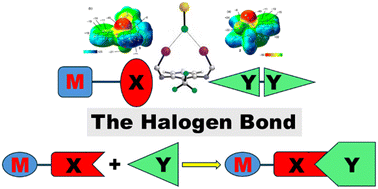
The halogen bond (XB) is denoted as R–X⋯Y, where the halogen atom X is covalently linked to the R group and possesses a potentially electrophilic region on its electrostatic potential surface, while Y is an anionic/neutral species with at least one nucleophilic centre that may donate electron density (an XB acceptor). For more than two decades, scientists have worked to clarify the nature of halogen bonds in order to advance their applications. Halogen bond finds utility in the absorption of drugs and their delivery to the target tissues, and thyroid hormones T3 and T4 serve as XB donors in biomolecular systems. This concept has also been explored in organocatalysis, supramolecular chemistry as well as in crystal engineering. There are only a few reports of metal-mediated transformation via XB. In fact, there are only few cases of XB formation to metal halides where some other ligands behave as Lewis bases in the complexes. Ligand exchange via the formation of a halogen bond (XB) has been observed only in a few cases, but this finding is very useful for the development of M–X bond activation processes that are stimulated by halogen-bond formation in certain intermediate steps. In this perspective article, we summarize the key developments in this field, where the role of XB in metal-halogen bond activation with concomitant substitution is discussed with some details on the theoretical mechanistic insights and relevant experimental evidences.
 Please wait while we load your content...


