


 PLATFORM UPDATE:


Study on terahertz spectroscopy and weak intermolecular interactions of methylparaben under temperature effects
 ab
ab
Abstract
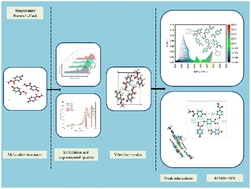
Herein, terahertz time-domain spectroscopy (THz-TDS) is used to measure the terahertz spectra of methylparaben (MeP) in the frequency range of 0.5–3.0 THz at different temperatures of 300 K, 330 K, 360 K, and 390 K. Theoretical calculations were conducted using the quasi-harmonic approximation (QHA) method at temperatures of 180 K, 240 K, 300 K, and 360 K. The influence of temperature on the terahertz response of MeP molecules was explored in depth. Both the experimental and theoretical results indicate that as the temperature increases, the terahertz spectrum of this frequency band tends to shift towards the low-frequency region. To further explore the mechanism of this phenomenon, we further used the VMARD method combined with atomic displacement maps to allocate and analyze the vibration modes of each absorption peak at different temperatures. The results indicate that with changes in temperature, there are significant differences in the dominant mechanisms and motion distribution characteristics of each vibration mode, but their motion is still mainly concentrated in the rotational motion of molecules or functional groups. In addition, we used an independent gradient model based on the Hirshfeld partition (IGMH) method combined with atoms in molecules (AIM) theory to explore the effect of temperature on weak interactions in MeP crystals. It was found that the strength of hydrogen bonds varies with temperature, which in turn affects the basic characteristics of weak interactions. This study not only deepens the understanding of the thermodynamic behavior of MeP molecules, but also provides an important theoretical basis and technical support for the thermal stability regulation of materials in the food, cosmetics, and pharmaceutical industries.
 Please wait while we load your content...


