


Conformational preferences of diimide-based dicarboxylate species and their coordination polymers
 *a
and
David R.
Turner
*a
*a
and
David R.
Turner
*a
Abstract
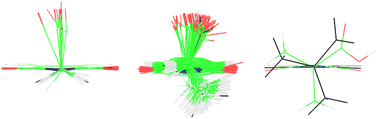
Structural reproducibility, in terms of ligand conformation and subsequent predictability, has been explored for five-membered imide-based ligands. Three dicarboxylic acids, based on a pyromelliticdiimide core appended with amino acids, have been synthesised, structurally characterised, and used in the (attempted) synthesis of coordination polymers. The diacids differ in steric bulk at the α-carbon by varying the precursor between glycine (2× H), alanine (1× H, 1× CH3) and aminoisobutyric acid (2× CH3). Coordination polymers containing the glycine- and alanine-derived dicarboxylates (GlyPmDI2− and AlaPmDI2−, respectively) were synthesised, although none could be isolated containing the most sterically encumbered ligand (ibaPmDI2−). The glycine-based coordination polymers show close, parallel stacking of the ligands, whereas the alanine-based coordination polymers do not. The conformation of the coordinating group with respect to the core of the ligand was studied by comparison of crystallographic data and computationally minimised structures. The preferred geometry of the ligand is shown to be dependent on the α-carbon substituents. For each ligand the geometry is reasonably predictable despite the ability of the terminal groups to rotate freely in solution.
 Please wait while we load your content...


