


Preparation and application of advanced nanoporous GaN materials

Abstract
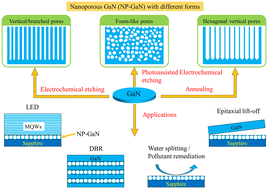
Nanoporous gallium nitride (NP-GaN) possesses several advantages, including a large specific surface area, abundant surface active sites, a tunable bandgap, and high light extraction efficiency. It has been used in light-emitting devices, photocatalytic applications, laser emitters, and energy storage systems. This paper reviews three primary preparation methods for NP-GaN: electrochemical etching (ECE), photoassisted electrochemical etching (PECE), and annealing. The pore-forming mechanisms and key influencing factors of each method are detailed. In ECE and PECE, porous structures are formed through the oxidation of GaN by holes generated under applied voltage or illumination. The pore morphology can be controlled by the doping density of the GaN sample, the voltage applied to the GaN sample and electrolyte composition. The annealing method relies on the preferential decomposition of GaN at defect sites under elevated temperatures to form porous structures. The pore size and distribution are influenced by annealing temperature and duration. Furthermore, this paper summarizes the applications of NP-GaN in light-emitting diodes (LEDs), photocatalysis, distributed Bragg reflectors (DBRs), epitaxial lift-off, and electrode materials. By comparing the merits and limitations of these preparation techniques, this review provides valuable insights for the future development and practical application of NP-GaN.
 Please wait while we load your content...


