


Study on the mechanism of morphology regulation of Pb-based MOFs and catalytic thermal decomposition mechanism of energetic materials
 a
a
Abstract
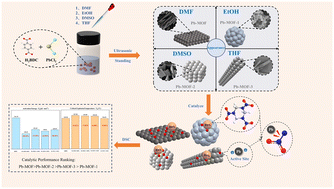
Efficient thermal decomposition of energetic materials is crucial for solid propellant energy release, yet conventional catalysts suffer from bottlenecks such as insufficient exposure of active sites and poor thermal stability. In this paper, we have synthesised four Pb(II)-based metal–organic frameworks (MOFs), Pb-MOF, Pb-MOF-1, Pb-MOF-2, Pb-MOF-3, using a solvent engineering strategy, and have investigated the evolution of different solvent-regulated crystalline morphologies by XRD and SEM, and the XPS reveals that the binding energy of the Pb–O bond is significantly reduced to 529.7 eV, which forms the electron-rich oxygen species, enhancing its catalytic ability. After the modulation of morphology, the activation energy of RDX is reduced by 50.2%, and the critical explosion temperature is increased by 21.98 °C. The Pb-MOF samples show excellent performance in catalysing the thermal decomposition of RDX. In this study, we investigate the directional evolution of MOF morphology, establish a new mechanism of morphology regulation, and provide a new methodology for the catalytic preparation of MOFs.
 Please wait while we load your content...


