


Nickel(ii) complexes of halogen-containing NNO donor aroylhydrazones as potential putative binders against SARS CoV-2 Mpro
 a
M.
Bhagiyalakshmi,
*a
M. R. Prathapachandra
Kurup,
*a
E.
Manoj,
b
Krishna K.
Damodaran,
c
M.
Sithambaresan
d
and
a
M.
Bhagiyalakshmi,
*a
M. R. Prathapachandra
Kurup,
*a
E.
Manoj,
b
Krishna K.
Damodaran,
c
M.
Sithambaresan
d
and
Abstract
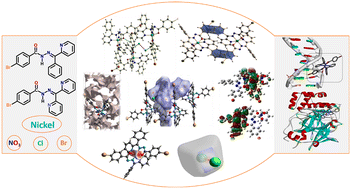
To ascertain the influence of aroylhydrazone proligands 2-benzoylpyridine-4-bromobenzhydrazone (HBpB) and di-2-pyridyl ketone-4-bromobenzhydrazone (HDpB) on the coordination with the Ni(II) metal center and resulting supramolecular structures, six nickel(II) complexes such as [Ni(BpB)2] (1), [Ni(BpB)(HBpB)]NO3 (2), [Ni(BpB)(HBpB)]Cl (3), [Ni(BpB)(HBpB)]Br (4), [Ni(DpB)2] (5) and [Ni(HDpB)(DpB)]NO3 (6) have been synthesized in high yield. The synthesized compounds were physico-chemically characterized by CHNS elemental analysis, molar conductivity, FT-IR spectra, and single crystal X-ray diffraction study. Single crystals of all the complexes (1–6) have been solved, which disclose the distorted octahedral geometry where complexes 1–3 and 6 crystallized in monoclinic lattices with P21/n space group, 4a crystallized in monoclinic lattices with P21 space group and complex 5a crystallized in triclinic lattices with P![[1 with combining macron]](https://www.rsc.org/images/entities/char_0031_0304.gif) space group. The N–H⋯O, N–H⋯N, N–H⋯Cl, N–H⋯Br, C–H⋯N, C–H⋯O, and C–H⋯Br type hydrogen bonds stabilize the supramolecular assemblies revealing fascinating graph-set motifs. Molecular Hirshfeld surface (HS) analyses and 2D fingerprint plots were used to decode all types of non-covalent interactions within the crystal networks. Atomic HS analysis of the Ni2+ centers reveals that the Ni–N metal–ligand interactions are significantly stronger than the Ni–O interactions. The theoretical analysis was performed to explore the properties of frontier orbitals and the stability of the complexes, and the electrostatic potential plots were mapped on optimized geometries. Complexes display three-dimensional (3D) supramolecular structures based on interchain halogen⋯halogen interactions, chalcogen⋯chalcogen, π⋯π interactions and hydrogen bonding. Additionally, thermal analysis, X-ray powder diffraction, and UV-vis absorption spectroscopy have been conducted. The compounds were also subjected to molecular docking studies with B-DNA and SARS-CoV-2 targets. Interestingly, all the complexes are found to have better putative binding potential compared to repurposed drugs against SARS CoV-2 Mpro.
space group. The N–H⋯O, N–H⋯N, N–H⋯Cl, N–H⋯Br, C–H⋯N, C–H⋯O, and C–H⋯Br type hydrogen bonds stabilize the supramolecular assemblies revealing fascinating graph-set motifs. Molecular Hirshfeld surface (HS) analyses and 2D fingerprint plots were used to decode all types of non-covalent interactions within the crystal networks. Atomic HS analysis of the Ni2+ centers reveals that the Ni–N metal–ligand interactions are significantly stronger than the Ni–O interactions. The theoretical analysis was performed to explore the properties of frontier orbitals and the stability of the complexes, and the electrostatic potential plots were mapped on optimized geometries. Complexes display three-dimensional (3D) supramolecular structures based on interchain halogen⋯halogen interactions, chalcogen⋯chalcogen, π⋯π interactions and hydrogen bonding. Additionally, thermal analysis, X-ray powder diffraction, and UV-vis absorption spectroscopy have been conducted. The compounds were also subjected to molecular docking studies with B-DNA and SARS-CoV-2 targets. Interestingly, all the complexes are found to have better putative binding potential compared to repurposed drugs against SARS CoV-2 Mpro.
 Please wait while we load your content...


