Carbocyclization-Oximation of Alkenes via Boryl Radical-Mediated Halogen Atom Transfer to Access Fluorinated 4-(Carbaldehyde Oxime)Quinolinones

Abstract

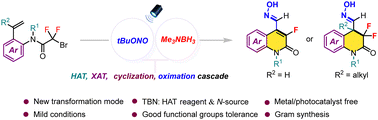
Distinct from traditional Giese-type hydroalkylations of alkenes via boryl radical-mediated halogen-atom transfer (XAT), a novel tandem strategy enabled by the dual-role reagent tert-butyl nitrite (TBN) is reported herein for the cyclizative difunctionalization of alkenes, delivering valuable 4-(carbaldehyde oxime)-fluorinated quinolinones. The protocol operates under mild, metal- and photocatalyst-free conditions, featuring a broad substrate scope, good functional group compatibility, and scalability.
Supplementary files

Article information

Article type
Communication
Submitted
13 Apr 2026
Accepted
20 May 2026
First published
21 May 2026

Chem. Commun., 2026, Accepted Manuscript

Carbocyclization-Oximation of Alkenes via Boryl Radical-Mediated Halogen Atom Transfer to Access Fluorinated 4-(Carbaldehyde Oxime)Quinolinones

M. Tian, Q. Dong, R. Fu, Y. Zhang, T. Chen and K. Sun, Chem. Commun., 2026, Accepted Manuscript , DOI: 10.1039/D6CC02257J

To request permission to reproduce material from this article, please go to the Copyright Clearance Center request page.

If you are an author contributing to an RSC publication, you do not need to request permission provided correct acknowledgement is given.

If you are the author of this article, you do not need to request permission to reproduce figures and diagrams provided correct acknowledgement is given. If you want to reproduce the whole article in a third-party publication (excluding your thesis/dissertation for which permission is not required) please go to the Copyright Clearance Center request page.

Read more about how to correctly acknowledge RSC content.

Social activity

Spotlight

Advertisements