


 PLATFORM UPDATE:


Dense crystalline–amorphous heterointerface catalysts for freshwater/seawater splitting and small molecule synergistic electrolysis

Abstract
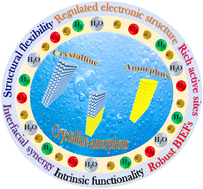
The crystalline–amorphous (c–a) heterointerface represents an innovative approach that provides a transformative strategy to overcome the challenges associated with conventional catalyst configurations. By integrating the broad-range electronic conductivity and mechanical strength of crystalline phases with the coordinatively unsaturated sites and configurational entropy of amorphous domains, these hybrid heterostructures establish distinct interfacial regions that fundamentally modify adsorption energetics, reaction pathways, and durability under operating conditions. This review offers an in-depth and critical evaluation of the growing domain of c–a dense heterointerfaces in catalysis, emphasizing sustainable energy conversion processes such as the hydrogen evolution reaction (HER), oxygen evolution reaction (OER), freshwater/seawater splitting, and small molecule synergistic electrolysis. We primarily highlight the core aspects (e.g., interfacial synergism, dynamic reconstruction and self-optimization, electronic configuration, balanced crystallinity and amorphicity) that regulate interfacial development, underscoring the underlying thermodynamic and kinetic principles that influence the efficiency of c–a heterojunctions. We proceed to assess the catalytic performance in major electrochemical and thermochemical reactions, establishing correlations that translate interfacial motifs into activity, selectivity, and stability attributes. Particular emphasis is placed on the mechanistic value of dense heterointerface engineering in regulating the overall electronic configuration, directing chemical intermediates, and offering remarkable resistance to corrosion and material dissociation. Finally, the challenges that confront the field and feasible opportunities to expedite the transition of c–a heterointerfaces from fundamental advancement to applicable catalytic technologies are presented. This study seeks to bring together existing knowledge and outline future trajectories, positioning c–a heterointerfaces as a robust and adaptable foundation for the forthcoming generation of high-performance catalysis.
 Please wait while we load your content...


