Constant-Potential DFT Insights into CO₂ Electroreduction on Fe3 and Cu3 Clusters Supported by N-Doped Graphene

Abstract

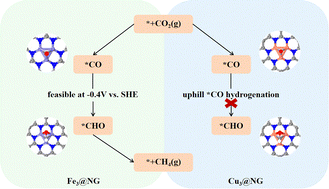
Constant-potential DFT reveals distinct CO₂ reduction behavior onFe₃ and Cu₃ clusters supported on N-doped graphene. Fe₃@NG enables deep reduction toward CH₄ at mild cathodic bias, whereas Cu₃@NG remains limited by uphill *CO hydrogenation. This contrast originates from Fe-induced electronic modulation that promotes CO₂-derived intermediate activation.Electrocatalytic CO₂ reduction reaction (CO₂RR) offers a promising route for converting CO₂ into value-added chemicals using renewable electricity under mild conditions. 1-3 However, its practical implementation remains challenging because the high thermodynamic stability of CO₂, the complexity of multielectron/proton transfer pathways, and the competing hydrogen evolution reaction (HER) together hinder both activity and product selectivity. [4][5][6] Developing electrocatalysts that can efficiently activate CO₂ while steering reaction pathways toward desired products is therefore central to advancing CO₂RR.Single-atom catalysts (SACs) have attracted extensive interest in CO₂RR due to their high atomic utilization and well-defined active sites. [7][8][9][10] Extending this concept from isolated atoms to atomically precise clusters offers additional opportunities to tune local geometry, metal-metal cooperation, and electronic structure while retaining high metal efficiency. [11][12][13] In particular, triatomic clusters have recently emerged as promising CO₂RR motifs, showing enhanced activity and product tunability across different supports and metal compositions. [14][15][16][17][18] However, most theoretical studies on such systems still rely on the conventional computational hydrogen electrode (CHE) framework, which cannot explicitly capture the electrode-potential-dependent evolution of electronic states and adsorbate thermodynamics. [19][20][21] This limitation is particularly critical for small cluster catalysts, whose reactivity is highly sensitive to charging and interfacial electric fields.

Supplementary files

Article information

Article type
Communication
Submitted
19 Mar 2026
Accepted
08 Apr 2026
First published
09 Apr 2026

Chem. Commun., 2026, Accepted Manuscript

Constant-Potential DFT Insights into CO₂ Electroreduction on Fe3 and Cu3 Clusters Supported by N-Doped Graphene

Z. Mou and J. Liu, Chem. Commun., 2026, Accepted Manuscript , DOI: 10.1039/D6CC01652A

To request permission to reproduce material from this article, please go to the Copyright Clearance Center request page.

If you are an author contributing to an RSC publication, you do not need to request permission provided correct acknowledgement is given.

If you are the author of this article, you do not need to request permission to reproduce figures and diagrams provided correct acknowledgement is given. If you want to reproduce the whole article in a third-party publication (excluding your thesis/dissertation for which permission is not required) please go to the Copyright Clearance Center request page.

Read more about how to correctly acknowledge RSC content.

Social activity

Spotlight

Advertisements