Boosting Alkaline Nitrate Reduction to Ammonia via Molybdenum-Mediated Hydrogenation on CuO Nanoarrays

Abstract

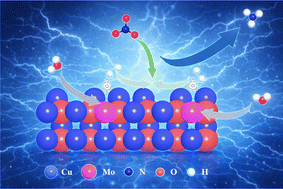
Herein, we report Mo-doped CuO nanoarrays (NAs) synthesized via a facile method. The incorporation of Mo modulates the electronic structure of Cu and introduces robust H* adsorption sites, significantly accelerating the rate-determining hydrogenation steps. The optimized Mo1-doped CuO NAs achieve a peak Faradaic efficiency of 90.1% for NH3 and a yield rate of 7.8 ± 0.1 mg h-1 cm-2 at -0.6 V vs. RHE. This work provides insights into the synergistic effects of Mo-doping for high-efficiency NO3- upcycling in alkaline environments.

Supplementary files

Article information

Article type
Communication
Submitted
14 Mar 2026
Accepted
07 May 2026
First published
08 May 2026

Chem. Commun., 2026, Accepted Manuscript

Boosting Alkaline Nitrate Reduction to Ammonia via Molybdenum-Mediated Hydrogenation on CuO Nanoarrays

Y. Wang, Z. Li, J. Hu and L. Fang, Chem. Commun., 2026, Accepted Manuscript , DOI: 10.1039/D6CC01545J

To request permission to reproduce material from this article, please go to the Copyright Clearance Center request page.

If you are an author contributing to an RSC publication, you do not need to request permission provided correct acknowledgement is given.

If you are the author of this article, you do not need to request permission to reproduce figures and diagrams provided correct acknowledgement is given. If you want to reproduce the whole article in a third-party publication (excluding your thesis/dissertation for which permission is not required) please go to the Copyright Clearance Center request page.

Read more about how to correctly acknowledge RSC content.

Social activity

Spotlight

Advertisements