Bioinspired Metal-Organic Helicate Drives Electrocatalytic Ethane Production from Carbon Dioxide

Abstract

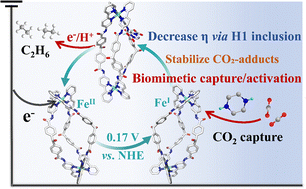
We designed an enzymatic metal-organic cages (MOCs) H1 electrocatalysts, which activates the in situ formed adduct between CO₂ and piperazine via host-guest encapsulation, thereby significantly lowering CO₂ reduction potential and achieving the lowest potential CO₂ to ethane conversion at -0.13 V vs. reversible hydrogen electrode, RHE. The catalytic system delivers a Faradaic efficiency (FE) of 36.8% for C2H6, while maintaining stable performance over 20 hours of continuous operation.
Supplementary files

Article information

Article type
Communication
Submitted
10 Mar 2026
Accepted
13 Apr 2026
First published
14 Apr 2026

Chem. Commun., 2026, Accepted Manuscript

Bioinspired Metal-Organic Helicate Drives Electrocatalytic Ethane Production from Carbon Dioxide

L. Gao, J. Wang, K. Shen, X. Jing and C. Duan, Chem. Commun., 2026, Accepted Manuscript , DOI: 10.1039/D6CC01440B

To request permission to reproduce material from this article, please go to the Copyright Clearance Center request page.

If you are an author contributing to an RSC publication, you do not need to request permission provided correct acknowledgement is given.

If you are the author of this article, you do not need to request permission to reproduce figures and diagrams provided correct acknowledgement is given. If you want to reproduce the whole article in a third-party publication (excluding your thesis/dissertation for which permission is not required) please go to the Copyright Clearance Center request page.

Read more about how to correctly acknowledge RSC content.

Social activity

Spotlight

Advertisements