


Axial chlorine coordination reconstructs Fe–N4 electronic structure for efficient pH-universal oxygen reduction reaction

Abstract
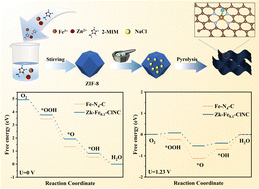
Current Fe single-atom catalysts suffer from active-site blockage and aggregation. This study creates 2D nanosheet catalysts with axial chlorine-coordinated Fe–N4 sites (Fe–N4Cl) via molten salt-assisted pyrolysis. This configuration tunes the electronic structure, enhancing oxygen reduction. The catalyst outperforms Pt/C in alkaline, neutral, and acidic electrolytes, with half-wave potentials of 0.921 V, 0.742 V, and 0.771 V, respectively. In Zn–air batteries, it achieves a high power density of 176.5 mW cm−2 and stability over 720 hours, showing great potential for efficient energy conversion.
 Please wait while we load your content...


