


Experimental and spectroscopic evidence of the hidden triplet transition state of quinone methide: a new reactivity paradigm

Abstract
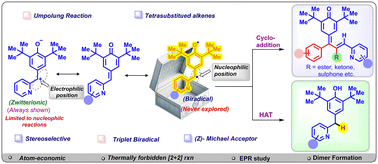
Quinone methides (QMs), a versatile class of reactive intermediates known for centuries, have been shown to exist predominantly in two structural states, namely neutral and zwitterionic states, with the latter acting as an excellent electrophilic synthon that readily reacts with a wide range of nucleophiles. Herein, we unequivocally reveal the latent triplet biradical canonical form of the para-quinone methide based on experimental results, which are corroborated by spectroscopic analyses. Notably, this canonical form exhibits typical radical-like reactivity, including the ability to participate in addition reactions with alkenes as well as alkynes, formation of adducts with TEMPO, hydrogen atom transfer reactions, etc. Leveraging this biradical structural feature, we have constructed a variety of scaffolds with both synthetic and pharmacological importance, such as s-cis dienes and diaryl- or triaryl-methanes. Furthermore, the synthesized products can be readily transformed into tetra-substituted alkenes.
 Please wait while we load your content...


