Pulse-electrodeposited Cr/Fe–Ni(OH)2 on nickel felt for scalable fabrication of a highly efficient and stable anode for seawater splitting

Abstract

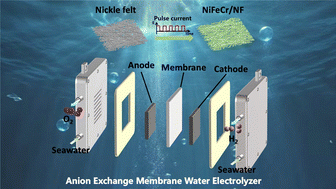
Electrocatalytic anodes applied in seawater splitting should be highly efficient and resistant to corrosion by chloride ions. Herein, a pulse electrodeposition method has been applied to fabricate Cr/Fe–Ni(OH)2-based catalysts on nickel felt. Cr, acting as a Lewis acid site, locally enriches OH ions, thereby enhancing chloride corrosion resistance while regulating the electronic structure of adjacent nickel/iron sites. As a result, the as-prepared anode achieved a low overpotential of 203.8 mV at a current density of 10 mA cm−2. Moreover, this method for the production of the anode is scalable. A 4 cm × 4 cm anode assembled into an anion-exchange membrane electrolyzer achieved a current density of 1000 mA cm−2 at a low cell voltage of 1.837 V. Overall, this work provided a feasible method to prepare large-scale anodes with highly efficient activity and high resistance to Cl in seater splitting.

Graphical abstract: Pulse-electrodeposited Cr/Fe–Ni(OH)2 on nickel felt for scalable fabrication of a highly efficient and stable anode for seawater splitting

Supplementary files

Article information

Article type
Communication
Submitted
06 Nov 2025
Accepted
08 Dec 2025
First published
09 Dec 2025

Chem. Commun., 2026, Advance Article

Pulse-electrodeposited Cr/Fe–Ni(OH)2 on nickel felt for scalable fabrication of a highly efficient and stable anode for seawater splitting

Y. Liu, Z. Zhao, Y. Chen, J. Hu and X. Meng, Chem. Commun., 2026, Advance Article , DOI: 10.1039/D5CC06320E

To request permission to reproduce material from this article, please go to the Copyright Clearance Center request page.

If you are an author contributing to an RSC publication, you do not need to request permission provided correct acknowledgement is given.

If you are the author of this article, you do not need to request permission to reproduce figures and diagrams provided correct acknowledgement is given. If you want to reproduce the whole article in a third-party publication (excluding your thesis/dissertation for which permission is not required) please go to the Copyright Clearance Center request page.

Read more about how to correctly acknowledge RSC content.

Social activity

Spotlight

Advertisements