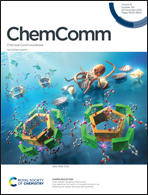
Disruption of a hydrogen-bond network at an Si/PNMPy/electrolyte interface for accelerated ion transfer in solar rechargeable devices

Abstract

Si/poly(N-methylpyrrole) (PNMPy)-based two-electrode solar rechargeable devices using HClO4 as the electrolyte exhibit 3-fold and 7-fold higher current densities during photo-charging and dark-discharging processes than does the corresponding H2SO4-based device. This enhancement originates from a ClO4-induced disruption of the interfacial hydrogen-bond network, where this disruption can significantly accelerate ion transfer at the PNMPy/HClO4 interface.

Graphical abstract: Disruption of a hydrogen-bond network at an Si/PNMPy/electrolyte interface for accelerated ion transfer in solar rechargeable devices

Supplementary files

Article information

Article type
Communication
Submitted
24 Oct 2025
Accepted
27 Nov 2025
First published
28 Nov 2025

Chem. Commun., 2026, Advance Article

Disruption of a hydrogen-bond network at an Si/PNMPy/electrolyte interface for accelerated ion transfer in solar rechargeable devices

D. Jiang, Y. Fu, Y. Zheng, Z. Wan, R. Ding, B. Wang, B. Wang, Q. Wang, C. Wan, Z. Zou and W. Luo, Chem. Commun., 2026, Advance Article , DOI: 10.1039/D5CC06048F

To request permission to reproduce material from this article, please go to the Copyright Clearance Center request page.

If you are an author contributing to an RSC publication, you do not need to request permission provided correct acknowledgement is given.

If you are the author of this article, you do not need to request permission to reproduce figures and diagrams provided correct acknowledgement is given. If you want to reproduce the whole article in a third-party publication (excluding your thesis/dissertation for which permission is not required) please go to the Copyright Clearance Center request page.

Read more about how to correctly acknowledge RSC content.

Social activity

Spotlight

Advertisements