


Harnessing topological porphyrin frameworks for synergistic H2O2 generation and furfuryl alcohol oxidation

Abstract
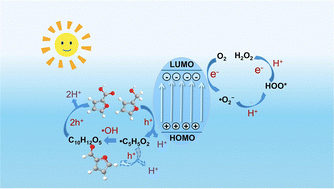
Metal–organic frameworks (MOFs) are promising for photocatalytic hydrogen peroxide (H2O2) production due to their porous structure and tunable active sites. However, inefficient charge carrier separation often limits their performance. This study investigates two porphyrin-based topological isomeric MOFs, PCN-134 and PCN-224, to elucidate the impact of topological structure on coupled H2O2 production with furfuryl alcohol (FAL) oxidation. Under photocatalytic conditions, PCN-224 exhibited significantly higher H2O2 yield (9.04 mmol g−1 h−1) and superior FAL oxidation performance. The disparity is attributed to variations in their coordination environments, which modulate charge carrier dynamics to promote efficient charge separation and thereby facilitate the desired coupled redox reactions.
 Please wait while we load your content...


