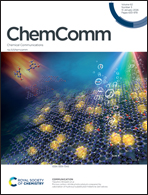
Quantifying the role of N-position in imine-based covalent organic frameworks for photocatalytic water splitting

Abstract

Through first-principles calculations, we investigated the role of N-site positioning in 2D COFs for modulating photocatalytic water splitting. Water activation at the pyridine N-site triggers protonation, inducing a push–pull electronic interaction, lowering the OER/HER thermodynamic barriers. Furthermore, N-atom positioning significantly alters the electron density and exciton binding energy, thereby improving the reaction thermodynamics.

Graphical abstract: Quantifying the role of N-position in imine-based covalent organic frameworks for photocatalytic water splitting

Supplementary files

Transparent peer review

To support increased transparency, we offer authors the option to publish the peer review history alongside their article.

View this article’s peer review history

Article information

Article type
Communication
Submitted
29 Sep 2025
Accepted
17 Dec 2025
First published
17 Dec 2025

Chem. Commun., 2026, Advance Article

Quantifying the role of N-position in imine-based covalent organic frameworks for photocatalytic water splitting

P. Chugh and A. Mahata, Chem. Commun., 2026, Advance Article , DOI: 10.1039/D5CC05533D

To request permission to reproduce material from this article, please go to the Copyright Clearance Center request page.

If you are an author contributing to an RSC publication, you do not need to request permission provided correct acknowledgement is given.

If you are the author of this article, you do not need to request permission to reproduce figures and diagrams provided correct acknowledgement is given. If you want to reproduce the whole article in a third-party publication (excluding your thesis/dissertation for which permission is not required) please go to the Copyright Clearance Center request page.

Read more about how to correctly acknowledge RSC content.

Social activity

Spotlight

Advertisements