


 PLATFORM UPDATE:


Coordination-driven liquid-to-solid phase transition and self-assembly of DNA–metal condensates

Abstract
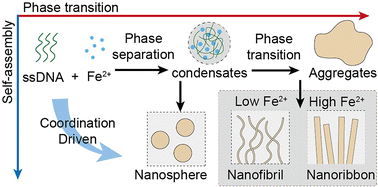
The biomolecular aggregates generated and maintained through phase separation contribute to the establishment of functionally oriented and ordered compartments in biological systems, which is crucial for intracellular activities. However, the mechanisms underlying the aggregation and dynamic transformation of biomacromolecules are not fully understood. In this paper, the phase separation and self-assembly of DNA and ferrous ions are reported to achieve a two-step structural change. DNA–Fe2+ condensates are initially formed by phase separation, followed by a phase transition from primary clusters into solid aggregates, and eventually lead to the self-assembly of nanofibrils or nanoribbons. The kinetic difference between phase separation and coordination-driven self-assembly enables this two-step morphological changes. In contrast to the conventional bottom-up self-assembly, this study reveals a novel self-organization mechanism for DNA–metal coacervates, in which the assembly occurs after phase separation and liquid-to-solid phase transition and provides kinetic insights into the underlying process.
 Please wait while we load your content...


