


UV-Vis determination of acetate in ethanol electrolysis for renewable hydrogen production

Abstract
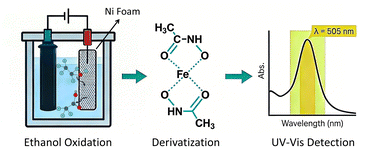
Electrochemical oxidation of ethanol can simultaneously produce hydrogen and value-added acetate, but accurate quantification of acetate in ethanol-rich, high-ionic-strength alkaline electrolytes remains challenging. Here, we report a cost-effective, sensitive UV-Vis spectrophotometric method for acetate determination based on carbodiimide-mediated derivatization: acetate is activated by N,N′-dicyclohexylcarbodiimide (DCC), converted to acetohydroxamic acid (AHA) by NH2OH HCl, and the resulting hydroxamate(s) are detected as chromogenic Fe3+–AHA complexes with a maximum at 505 nm. Reaction stoichiometry and temperature were optimized (0.1 mol L−1 NH2OH HCl, 0.4 mol L−1 DCC, 0.3 mol L−1 Fe3+, 60 °C) to maximize sensitivity and stability. Under these conditions, the assay exhibits a limit of detection of 6.27 × 10⁻⁵ mol L−1 and a limit of quantification of 1.90 × 10⁻⁴ mol L−1, with excellent linearity in the tested range. The method shows negligible interference from ethanol across typical sample concentrations in a pH range of 5–8 and tolerates acetaldehyde up to approximately twice the molar concentration of acetate; the derivatized signal remains stable for 120 min. Validation with electrolytes produced by ethanol electro-oxidation on Ni foam yielded acetate concentrations of 12.54, 35.94, 55.58 and 68.49 mmol L−1 and combined faradaic efficiencies above 94%, demonstrating practical applicability. This DCC→AHA→Fe3+ UV-Vis assay provides a simple, inexpensive, and robust approach for routine quantitative analysis of acetate in challenging, ethanol-rich alkaline matrices and is readily adaptable for laboratory studies of electrocatalytic ethanol oxidation.
- This article is part of the themed collection: Analytical Methods HOT Articles 2026
 Please wait while we load your content...


