


Construction of a near-infrared fluorescent probe for cysteine and its application in oxidative stress research
 †a
Hongmei
Liu
*a
†a
Hongmei
Liu
*a
Abstract
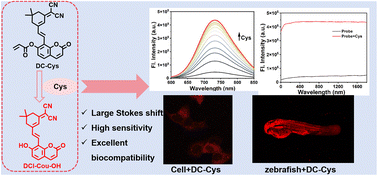
Cysteine (Cys) is a key endogenous thiol in the body, and its active sulfhydryl group plays a core role in physiological processes such as glutathione synthesis, antioxidation, protein disulfide bond formation, and metal ion homeostasis. Clinical studies have confirmed that abnormal intracellular Cys levels and oxidative stress damage are mutually causal and can exacerbate free radical reactions and induce neurodegeneration, liver injury, and cardiovascular diseases. Therefore, the development of high-spatiotemporal resolution Cys dynamic monitoring technology is of great significance. Fluorescent probe technology, with its non-invasive, high sensitivity, and subcellular resolution advantages, has become an ideal tool for studying Cys metabolism. In recent years, fluorescent probes with Cys-specific recognition, near-infrared emission, a large Stokes shift, and good biocompatibility have become a research hotspot. In this study, based on the Michael addition reaction, a novel near-infrared fluorescent probe, DC-Cys, was designed and synthesized. This probe has a large Stokes shift (210 nm), a low detection limit (23 nmol L−1), high sensitivity, and good biocompatibility. It was successfully applied in LPS-induced cell and zebrafish oxidative stress models to achieve real-time dynamic imaging of Cys and to evaluate the intervention effect of antioxidant drugs. DC-Cys provides a powerful tool for the study of oxidative stress mechanisms and related disease diagnosis and treatment.
 Please wait while we load your content...


