


Ecologically benign S-doped g-C3N4 nano-architectonics for rapid and selective fluorescent detection of the jaundice biomarker bilirubin
 *ab
and
Shanmugam
Senthil Kumar
*ab
*ab
and
Shanmugam
Senthil Kumar
*ab
Abstract
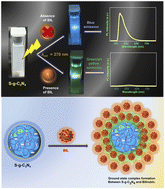
Development of a label-free biomolecular sensor probe without complex pre-treatment offers potential for advanced point-of-care clinical diagnosis. This study explores the kinetic and thermodynamic interactions between fluorophore sulfur-doped graphitic carbon nitride (S-g-C3N4) and the analyte bilirubin (BIL). S-g-C3N4 was synthesized through a green approach using thiourea as the source of sulfur and nitrogen. S-g-C3N4 exhibits strong blue fluorescence emission at 439.46 nm, with a purity of 67.12%. The addition of target BIL leads to selective fluorescence quenching without the need for an external label, following a synergistic static and dynamic mechanism. Static quenching occurs due to the formation of a ground-state complex through hydrogen bonding. Dynamic quenching is indicated by a reduction in the excited-state lifetime, which decreases from 2.17 ns to 1.71 ns. The probe demonstrates admirable sensitivity for BIL detection across a range of 0.04–70 µM, with a detection limit of 0.0256 µM. It performs reliably in both synthetic and real human urine samples. The practical applicability of the prepared fluorescence probe was further visualized by human fingerprint imaging. These comprehensive analyses substantiate the design of a highly selective method for BIL detection that can be customized as a simple, non-invasive, and stable diagnostic probe for biomolecular recognition.
 Please wait while we load your content...


