



Direct determination of creatinine biomarker in hemodialysis residual water and biological fluids using a copper nanoparticle-modified sensor
 *b
and
*b
and
Abstract
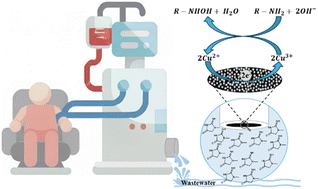
Creatinine is a compound naturally produced by the body through biochemical processes involving the metabolism of creatine phosphate in the muscles. It serves as an important biomarker for assessing kidney function, while also acting as a strong indicator of thyroid dysfunction and muscle injury. Therefore, the development of analytical methods aimed at rapid and efficient determination of creatinine is extremely important to assist in the diagnosis of these dysfunctional changes in the body, especially in relation to renal failure. In this context, the present study describes a fast, inexpensive, sensitive and highly reliable analytical methodology for the direct determination of creatinine in hemodialysis wastewater, artificial urine (simulating human urine) and bovine serum albumin (simulating human blood) samples. The method employs an electrochemical sensor based on a glassy carbon electrode (GCE) modified with copper nanoparticles (GCE-CuNPs). The GCE-CuNPs sensor was developed through amperometric modification of the GCE surface with CuNPs, followed by electroactivation via cyclic voltammetry in a 0.1 mol L−1 NaOH medium. Optimization studies identified the following parameters for optimal sensor performance: an electrodeposition time of 120 s, in an unstirred solution of CuSO4 6.0 mmol L−1 (precursor solution), an electrodeposition potential of −0.20 V and amperometric detection potential of 0.70 V. The developed electrochemical sensor exhibited a linear response for creatinine determination in the concentration range of 0.025 to 1.0 mmol L−1 with Iap (µA) = 0.029 [creatinine] (mmol L−1) + 1.92 × 10⁻⁷ (R2 = 0.9964), limit of detection (LOD) of 19.0 µmol L−1, limit of quantification (LOQ) of 58.0 µmol L−1 and sensitivity of 0.029 µA mmol−1 L. Additionally, the GCE-CuNPs sensor showed good repeatability, selectivity and average recoveries around 102.5% (n = 5). Finally, the GCE-CuNPs sensor was successfully applied for the determination of creatinine in hemodialysis wastewater, bovine serum albumin and artificial urine samples, demonstrating its practical utility.
 Please wait while we load your content...


