


Gamma-hydroxybutyric acid (GHB) derivatization with N-(3-dimethylaminopropyl)-N′-ethylcarbodiimide (EDC): LC-HRAM-Orbitrap-MS characterization of GHB and deuterated GHB derivatives and application to blood, urine, and hair analysis

Abstract
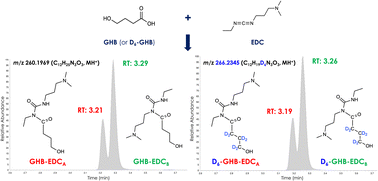
This paper describes a new analytical approach for determining gamma-hydroxybutyric acid (GHB) in biosamples using liquid chromatography-mass spectrometry (LC-MS) following derivatization with N-(3-dimethylaminopropyl)-N′-ethylcarbodiimide (EDC). The derivatization procedure is simple, rapid, reproducible, inexpensive, and safe. It allows for a complete variation of GHB chemical characteristics (from hydroxyacid to N-acylurea) with a molecular weight increase from 104 to 259 u and the introduction of 3 nitrogen atoms. These modifications promote the protonation of the analytes in the MS electrospray ion source, enabling MS detection under positive ionization conditions. Liquid chromatography-high-resolution accurate-mass Orbitrap mass spectrometry (LC-HRAM-Orbitrap-MS) measurements demonstrated that derivatization produces two GHB-EDC derivatives with the same exact mass (MH+ ions at m/z 260.1968) and experimental isotopic patterns overlapping each other and superimposable to the calculated one. Thus, they share an identical elemental composition (C12H25O3N3) but have different molecular structures (GHB-EDCA and GHB-EDCB). Equivalent results were obtained for D6-GHB: the production of two deuterated N-acylureas (D6-GHB-EDCA and D6-GHB-EDCB), with MH+ ions at m/z 266.2341, superimposable experimental and calculated isotopic patterns, elemental composition C12H19D6O3N3, and different molecular structures, mirroring those of GHB-EDCA and GHB-EDCB. After optimizing the derivatization conditions (reaction solvent, reaction temperature and time, and volume and concentration of the derivatizing agent) the final procedure involves reacting with 10 mM aqueous EDC, at 45 °C for 15 minutes. GHB-EDC derivatives were found to be highly stable over time (at least 15 days), even at room temperature. Three preliminary analytical methods for the determination of endogenous and exogenous GHB levels in urine, blood, and hair samples were developed.
 Please wait while we load your content...


