


A practical framework for super-resolution of mass spectrometry images via adaptation of deep learning models
 *ab
Chang
Li,
c
*ab
Chang
Li,
c
Abstract
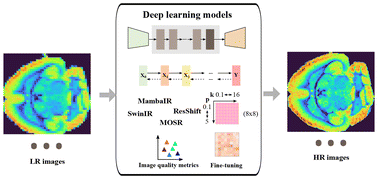
Achieving high spatial resolution is critical for revealing tissue-specific metabolite distributions in mass spectrometry imaging (MSI), yet practical constraints often limit achievable resolution. While deep learning offers promising post-acquisition enhancement, the relative efficacy of different generative architectures for MSI data remains inadequately explored. This study establishes a comparative evaluation of three advanced deep learning architectures (SwinIR, MambaIR, and ResShift) against the established GAN-based model MOSR. Evaluated across three MSI datasets and six image quality metrics, MOSR and a bicubic pre-trained ResShift model demonstrated superior capacity in reconstructing complex textural details. Capitalizing on this, we developed a focused transfer-learning strategy to adapt the pretrained ResShift model using only ten mouse brain sagittal section images. The fine-tuned model achieved a 41.5% improvement in a composite performance score over its pre-trained state and a 14.0% improvement over MOSR. Remarkably, this model generalized effectively to distinct anatomical planes (horizontal brain sections) and entirely different tissue types (mouse kidney), as validated using multiple metabolites. Our work provides a benchmark for generative models in MSI super-resolution and proposes a practical, data-efficient fine-tuning framework that enhances image fidelity across diverse biological samples, offering a computational tool for spatially resolved metabolomics.
 Please wait while we load your content...


