


A label-free approach to simultaneous determination of three endocrine disruptors in river water: angular sweep total fluorescence spectroscopy coupled to multi-way calibration
 *a
*a
Abstract
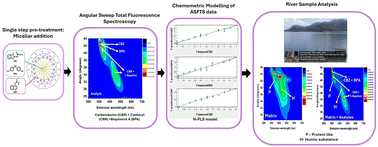
Monitoring organic pollutants in natural waters remains challenging due to the complexity of environmental matrices and the spectral overlap of fluorescent analytes. The carbamate pesticides carbaryl (CBR) and carbendazim (CBZ), along with the plasticizer bisphenol A (BPA), are of particular concern as endocrine disruptors but remain difficult to detect using intrinsic fluorescence because of overlapping emission profiles, BPA's weak aqueous fluorescence, and interference from dissolved organic matter. Here, we present the first application of Angular Sweep Total Fluorescence Spectroscopy (ASTFS) to a multi-fluorophoric system, coupled to multiway calibration, as a label-free strategy for the simultaneous detection of these pollutants. By acquiring total fluorescence through variable-angle scans, ASTFS enhances spectral resolution and enables discrimination of highly overlapped signals. Integration with micellar-assisted pre-treatment and N-way Partial Least Squares (N-PLS) regression yielded excellent predictive performance (R2 > 0.99; relative error <12%), with detection limits of 74.57 ng mL−1 (CBZ), 1.00 ng mL−1 (CBR), and 7.76 ng mL−1 (BPA). Application to river water samples confirmed robust performance despite matrix interference, achieving root mean square errors of prediction of 57.7 ng mL−1 (CBZ), 3.16 ng mL−1 (CBR), and 26.7 ng mL−1 (BPA), with recoveries of 101.5%, 99.7%, and 95.0%, respectively. This study establishes ASTFS as a powerful and accessible platform for simultaneous quantification of multiple fluorescent pollutants in complex environmental waters, advancing fluorescence-based environmental monitoring.
 Please wait while we load your content...


