


Progress of lateral flow assays for the detection of molecular and microbial species: from basic formats to microfluids, CRISPR and artificial intelligence

Abstract
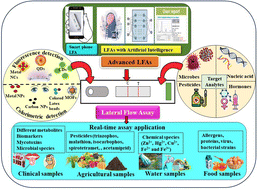
Lateral flow assays (LFAs) have garnered much interest in the biomedical and agricultural sciences because of their user-friendly design, quick turnaround times, minimal interference, affordability, and ease of use by individuals. To date, many researchers have reported the use of LFAs for microbial and molecular species identification in the area of clinical and environmental fields, respectively. In this review, we describe the progress in the design of LFA techniques from basic formats to advanced technology (artificial intelligence and machine learning programmes) for the detection of molecular and microbial species. The main objective of this review is to discuss potential applications of LFAs with advanced technology for the detection of molecular species (from molecular targets to whole cells) in real samples. In detail, we have discussed the principles, working, fabrication and the detection methods of LFAs. The modification of LFAs with various molecules (organic, polymers and biomolecules) and nanomaterials is summarized. Detection mechanisms of LFAs are discussed for the identification of molecular targets and cells. The further advancements in this technology are also highlighted along with its challenges and future perspectives.
 Please wait while we load your content...


